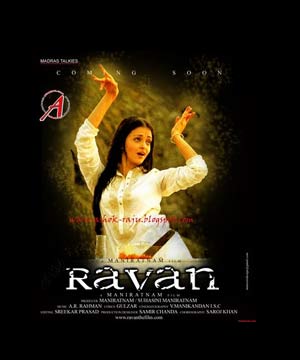
Have been listening to the music of Raavan non-stop. I had tweeted quite sometime back that rahman+gulzar = magic; and that's coming true again. The album has been an overwhelming experience with some fantastic and fresh sounds that haven't been heard before. Rahman's musical notes and Gulzar's thoughtful lyrics make for a great listening experience.
Let me start with the controversial topic of maoism/naxalism. Like Dil Se, Bombay and Roja, Mani Ratnam has picked up another socially relevant theme for the silverscreen. I loved his terror ravaged trilogy and this time around I am hoping that he has got it right again. The theme of naxalism is sprayed around by Gulzar in a strong yet poetic charm in two of the songs.
I shall first discuss the comical song Kata kata bechara bakra which is fun to begin with, but has the references to naxalites. The theme of the song is age-old, of a man getting married and hence being called 'bechara bakra' ready for the chopping block.
kata kata bechaara bakra kata kata bechaara
mana mana le khair maanale aakhari raat kuwaara
mana mana le khair maanale aakhari raat kuwaara
But soon after that follows these words :
dulhe miya dulhe miya dand-vand pelo
dulhe miya chhodo joru jhaarkhand le lo
dulhe miya chhodo joru jhaarkhand le lo
The village folks ask the guy to do some body-building [dand-vand pelo]; forget about his wife and chase the cause of 'jharkhand'. Gulzar slips in the message with such subtlety. The song has a beautiful earthy feel with Sapna Avasthi and Ila Arun bringing the folk flavor. This is only the second time that Sapna Avasthi has sung for Rahman, 10 years after Chaiyya Chaiyya, and she still sounds as energetic as she was back then.
Since we all know that the movie is titled Raavan for a reason. And where there is Raavan, there has to be a Ram and Sita too. This melancholic song Behne De sounds like Ram's heart bleeding for Sita after she has been kidnapped by Raavan.
Umeed ko aag laga zara
Sehra ki pyaas bujha zara
Ghan itna baras ke galne lagoon
Mei paani ke upar tarne lagoon
Sehra ki pyaas bujha zara
Ghan itna baras ke galne lagoon
Mei paani ke upar tarne lagoon
A man missing his sweetheart very badly, that's what the song is about. It also speaks about the deep bonding and love between two inseparable beings. It has the feel of emptiness and is expressed beautifully in words.
Shart lagi hai mar jaane ki
Jeena hai toh pyaar mei
Dil kahin bhi ho mera
Jaan rakhi hai yaar mei
Behja behja hai saagar ka kehna
Behja behja hai nadiya ko behna
Jeena hai toh pyaar mei
Dil kahin bhi ho mera
Jaan rakhi hai yaar mei
Behja behja hai saagar ka kehna
Behja behja hai nadiya ko behna

Coming back to the theme of naxalism, there is another song Thok De Killiwhich has been powerfully sung by Sukhwinder Singh. Its a scorn against the caste/class barrier, about the have's and have-nots. It first describes the condescending look that the upper caste/class people give to the downward trodden:
Sabko ghoore aankh dikhaye
Tanashahi kare daraye
Oh baakad billi hey
Tanashahi kare daraye
Oh baakad billi hey
And then, the song goes on to say that no one has ever discussed the problems of people below poverty line.
Aaja milke baithe
Haal sunaave dil ka
Kela woh khaate hain
Humko phenke chilka chilka
Haal sunaave dil ka
Kela woh khaate hain
Humko phenke chilka chilka
The despair of being teased as 'backward' is brilliantly penned in the song. The instrumentation is fabulous and the drum beats are that of an uprising against this class/caste barrier.
Pichde pichde keh ke humko
Khoob udaye khilli dilli
Sehte sehte ab toh
Gardan ghar rakh kar jaate hai
Choti ho gayi kabren
Bin mundi hi mar jaate hain
Khoob udaye khilli dilli
Sehte sehte ab toh
Gardan ghar rakh kar jaate hai
Choti ho gayi kabren
Bin mundi hi mar jaate hain
The gross violence inflicted against the backward castes by the upper-caste is very well described in the last 3 lines of the above stanza. It speaks of the gruesome acts of terror where people are beheaded callously and the body being buried while heads are being tossed out. Such a painful act of violence has been put down so effectively. I am sure the movie will capture the essence of the song well.
sadiyon se chalata aaya hai
unch ninch ka lamba kissa
abb ki baar hisaab chuka le
chir ke le le apna hisaa
apna khun bhi laal hi hoga
khol ke dekh le gaal ki jhilli
unch ninch ka lamba kissa
abb ki baar hisaab chuka le
chir ke le le apna hisaa
apna khun bhi laal hi hoga
khol ke dekh le gaal ki jhilli
And finally, the vengeful act of the maoist is spoken about. How they have decided to take law in their own hands and settle the score. The song will remain with you for long, that's for sure. This is one of the best songs of the movie, but unfortunately people will soon forget all the stanzas and only the start will be hummed.
Another song which will remain with you for long is Ranjha Ranjha Kardi Vey. A perfect song tailor-made for Rekha Bharadwaj to lend her vocals melodiously. Originally written and sung by Bulle Shah, we have had many versions of this including Abida Parveen's. Its a part of folk legends and this time Gulzar picks up this one.
Ranjha ranjha kardi vey mai
Aape ranjha hoyi
Aape ranjha hoyi
The song has a rustic rhythm and folksy feel to it. Rekha does complete justice to the song. Its a sad romantic song that describes the woes of love and the look out for that elusive lover who is nowhere to be seen.
Waqt katata bhi nahi
Waqt rukta bhi nahi
Dil hai sajde mei magar
Ishq jhukta bhi nahi
Waqt rukta bhi nahi
Dil hai sajde mei magar
Ishq jhukta bhi nahi
The pangs of separation is evident in the musical notes. And the soft singing adds to the sadness. Although I believe that Sonu could have done a better job because Khan has a hollow voice which does not emote much. There is no expression in his voice and that is one reason I have never been able to like Jashn-e-bahara song for Jodha-Akbar.
There is another romantic number Khili Re rendered by Renee Bharadwaj. That's the weakest song for me. Haven't liked it much until now.
Finally, I come to the new-age Raavan named Beera this time around. A naxalite out to fight against the system.
Beera ke dus maathe
Beera ke sau naam
Chhede jo beera ko
Dhama dham dham dham
Beera ke sau naam
Chhede jo beera ko
Dhama dham dham dham
The reference of dus-maathe could be about having a brilliant mind that does organizing, planning, plotting, communicating, executing the plan; all in one go. And the sau-naam would well be the many aliases that he is known by, just my guess of the interesting lyrics. The song has a lot of African drum-beats which gives it the much needed energy and aggression. At around 3 mins length, I felt it was short. I wished it was long 7-8 minute piece, but nope.
The album is a sure-shot success with great sounds, superb lyrics, fine instrumentation and some inspired singing. A great album indeed.
By the way, I got some clues on the storyline of the movie. If you can recall Khalnayak, its on those lines is what I can make of it. Madhuri Dixit aka Ganga is chsing Sanjay Dutt aka Ballu, while Ram is on the lookout for both. And when Ganga finally returns, she has to give her testimony in court to prove her innocence, much like Sita had to do after returning to Ayodhya. The difference is that, in Khalnayak , Ganga did not get kidnapped. In this movie, the leading lady gets nabbed by Beera. Another new addition is the presence of an emissary in the form of Govinda. This angle was not there in Khalnayak.
But I am sure it will not be this simple, Mani Ratnam definitely has some other plans; maybe a few twists in the storyline will make it interesting. Whatever it is, I am waiting for the movie to release. Desperate to watch it. Till then, let me immerse myself in the soundtrack of the movie.


